
11 Special Education Forms That Will Save You Hours Every Week

There was a point in my teaching career when I realized I was spending more time recreating the same paperwork than I was actually spending with my students.
Not because I was disorganized or I didn’t care. But because nobody had handed me the right systems, and I was building everything from scratch on top of an already impossible workload.
If your day disappears into tracking, logging, chasing down signatures, and documenting conversations you barely had time to have in the first place, you need a shift. The paperwork load in special education is real, and it’s relentless.
The good news is that the right special education forms do most of the heavy lifting for you. The eleven below are built specifically for the stuff that drains you fastest, the details that pile up, the data that gets missed, and the communication that has to be documented whether you have time for it or not.
A solid system, like the kind you use when you’re collecting input and baseline data for Individualized Education Programs, saves time before the paperwork snowballs. These forms work the same way. They catch the small stuff before it becomes a crisis.
1. Free IEP Writing Checklist — Start Here
Before anything else on this list, grab this. If IEP writing is the part of your job that takes the most time and causes the most stress, a clear checklist that walks you through every stage of the process is the fastest way to feel less overwhelmed and more in control.
This free IEP writing checklist was built specifically for special education teachers who are tired of staring at a blank screen and wondering what comes next. It keeps your Individualized Education Program process organized from start to finish, so you spend less time second-guessing and more time actually writing.
Yes, send me the free IEP writing checklist →
It’s free, it’s practical, and it’s a great place to start if you want your paperwork to feel less like a monster and more like a manageable process.
2. Free Parent and Guardian Communication Log for Compliance Verification
At some point in your career, you will have to prove that a conversation happened. Maybe it’s a question about procedural safeguards. Maybe it’s confirming parent consent was obtained, that a Prior Written Notice was delivered, or that translated forms were provided for a family who needed them.
The Free Parent and Guardian Communication Log means you jot it down once, keep it organized, and move on. No rebuilding records from memory. No searching through old emails at the worst possible moment.
“This has helped me keep much better track of my parent contact. All of the options in each section made it very easy to just check the box that applied. Thank you!”
— Kaylin ⭐ ⭐ ⭐ ⭐ ⭐
It’s free, it’s simple, and it’s one of the most important forms on this list.
3. Caseload and Marking Period Calendars for IEP Timeline Tracking
A generic planner doesn’t know that you have IEP meeting notices to send, legal timelines to hit during the reevaluation process, or progress reports due before the marking period ends. A calendar built for special education does.
Special Education IEP Caseload and Marking Period Calendars help you see what’s due, what’s coming, and what needs to happen before you get buried. When you can see the whole picture — meetings, deadlines, service timelines, meeting invitations, and reevaluation process milestones — you stop getting blindsided by things that were always on the calendar. You just couldn’t see them.
“Great resource to keep track of IEPs and stay organized.”
— Mellixa ⭐⭐⭐⭐⭐
4. Free Student IEP and Self-Advocacy Forms for Transition Services
When students understand their own Individualized Education Program, they can answer questions, share their needs, and actually participate in the IEP meeting instead of sitting there confused while the adults talk around them. That’s better for the student, and it saves you from doing all the talking.
What’s an IEP? Self-Determination and Self-Advocacy Forms are free and give you a clear, student-friendly way to gather input and build confidence without repeating the same explanations every single time. For older students preparing for transition services and their summary of performance, these forms are especially valuable. They build the skills students will need long after they leave your classroom.
“Helped my student with understanding their IEP.” — Sara ⭐⭐⭐⭐⭐
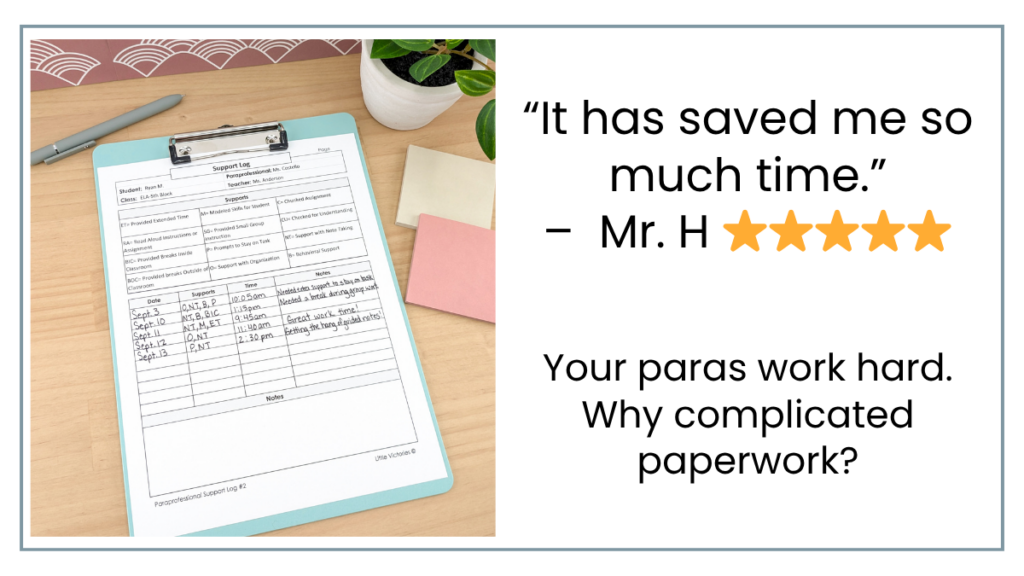
5. Paraprofessional Support Logs for Special Education Referral Documentation
When you’re managing multiple students and multiple adults, you need a fast way to see who helped, when they helped, and what was actually done. Without it, you’re piecing support together from memory at the end of the week, and memory is not documentation.
Paraprofessional Support Logs, Accommodation Tracking, and Checklists give you clean, consistent records that hold up during compliance verification, annual IEP reviews, and audits, without dragging you into another round of follow-up questions. These are the classroom forms that make the difference between scrambling and staying ahead throughout the special education referral process.
6. Behavior Data Tracking Sheets for Functional Behavioral Assessment
When a behavior concern escalates and everyone wants answers immediately, the last thing you want to say is “I have some notes somewhere.” You need real data, frequency, duration, ABC data, that tells a clear story and holds up in a functional behavioral assessment or behavior intervention plan update.
The Behavior Data Tracking Sheets Bundle helps you capture usable evidence as you go, so you’re never spending an afternoon trying to reconstruct what happened during third period two weeks ago. These data collection sheets mean fewer vague notes, fewer lost details, and a much cleaner paper trail when things get complicated. Plus, it includes ready-to-go graphing templates to just drop in your data, and wow you’re IEP teams!
“I love this resource. It seems easy to use, great for being on the go, and I love that it has self tracking graphs.” — Mollie ⭐⭐⭐⭐⭐
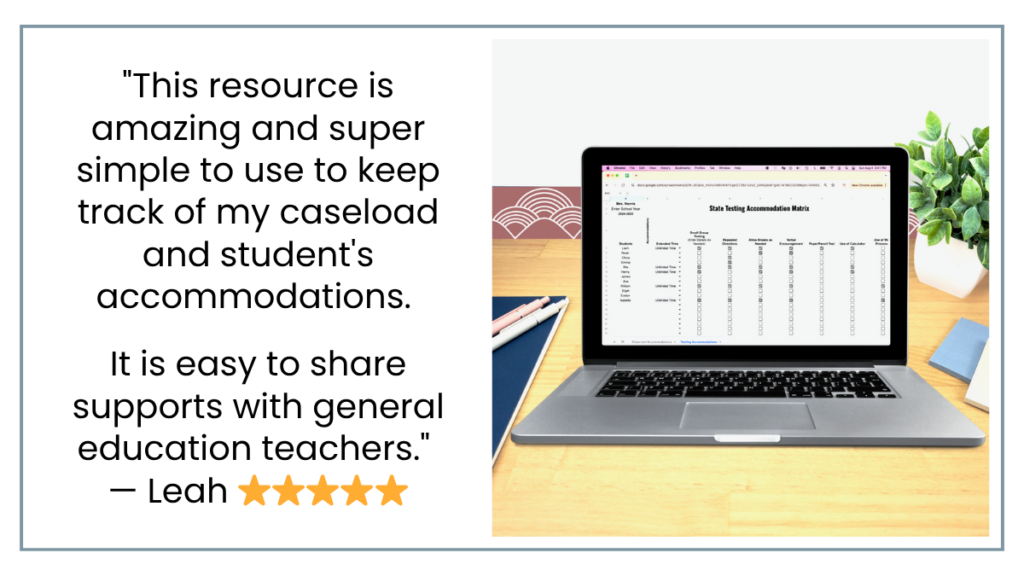
7. IEP Accommodations Tracker Matrix for 504 Plans and Eligibility Determination
You know how it goes. The Individualized Education Program says one thing, the classroom does another, and suddenly you’re the one trying to figure out what was actually provided and when. Whether you’re supporting students with a specific learning disability or students on 504 plans, lost accommodations create real problems, especially during eligibility determination or a manifestation determination review.
The IEP and 504 Accommodations Tracker Matrix gives you a simple place to document what support each student needs. Give a copy to each general education teachers so you have less constant follow-up and a cleaner paper trail when questions come up later.
8. Preference Assessment Forms for Behavior Intervention Plans and IEPs
If you’ve ever tried one reward after another only to watch a student shrug at all of them, you know how exhausting the guessing game gets. Motivation isn’t one-size-fits-all, and a behavior intervention plan built on the wrong reinforcers isn’t going to move the needle.
The Preference Assessment Bundle gives you a fast, structured way to figure out what actually matters to a student, making your reinforcement plans more targeted, your behavior support more effective, and your day a lot less full of trial-and-error guesswork. They’re also great to use when collecting the student’s input for their IEP!
“This has been the easiest preference assessment I have used, yet! I love the options that are provided.” — Kaite ⭐⭐⭐⭐⭐
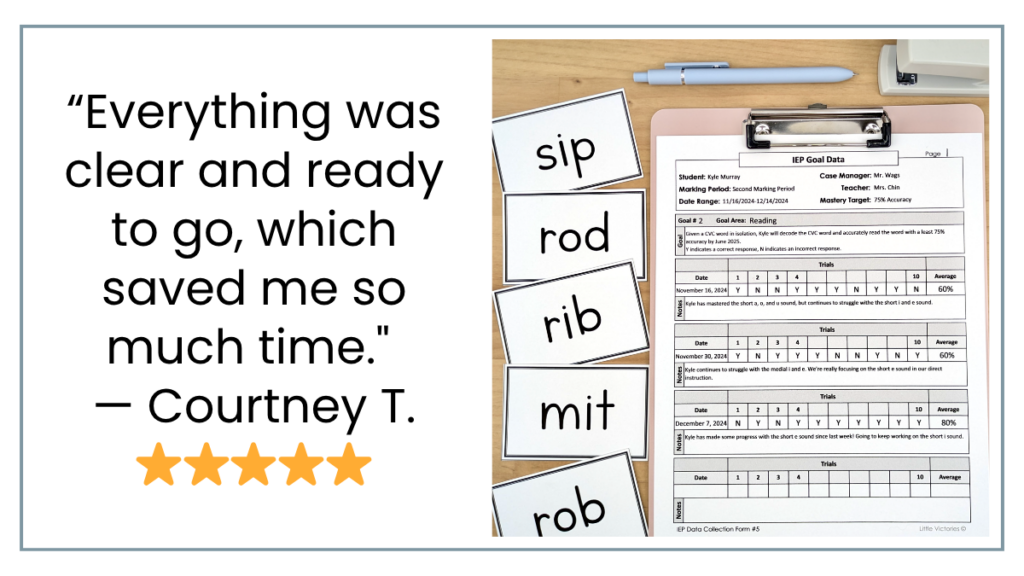
9. IEP Goal Tracking Sheets for Progress Monitoring and Evaluation Reports
If you’re digging through stacks of work samples and scattered notes every time a progress report is due, you already know how much time that wastes. If you really want to get your sanity back, a great step is to shift progress monitoring from a marathon session at the end of the marking period to a quickly weekly routine that takes just a minute.
IEP Goal Tracking Sheets and Data Collection Graphing help you record data in real time so you can see patterns, spot missing data, and write progress notes without staring at a blank screen. The organized data also feeds directly into the student’s next evaluation report, which means less starting from scratch when the reevaluation hits.
10. IEP Service Logs for Tracking Specially Designed Instruction and Other Services
Accurate service logs are not optional. They ensure and provide proof that the services int he Individualized Education Program promised were actually delivered. If you’ve ever had someone challenge if you’ve provided the required IEP minutes and had no clean record to look at, you know exactly how frustrating and defeating it can feel to not have something to hold up.
IEP Service Logs for Teachers and Related Service Providers keep the record right where you need it, organized, accessible, and ready to go, without adding a lot of extra work to your plate. Just jot your quick notes about the time and any details immediately following the service and take a deep breath.
“I absolutely loved this resource! It has helped me be able to keep track of my students’ minutes EASILY. I was even able to show my paraprofessionals how to use it and they caught on quickly. I love that there are different versions, so I can tailor it differently for each student.”
— Meghan B. ⭐⭐⭐⭐⭐
11. IEP Binder Bundle — All Your Special Education Forms in One Place
Here’s the honest truth: individual forms help. But when your caseload papers, student records, logs, trackers, and input sheets are scattered across folders, tabs, and sticky notes, you’re still losing time just finding what you need. Unlike special education software, a tangible system gives you quick compliance verification right at your fingertips, and this is it.
The IEP Binder Bundle for Special Education pulls the most-used special education forms into one organized system. One place to keep everything, find everything, and prove everything. If you’re already using individual forms and want the whole setup in one place at a better price, this is the one that makes the most sense.
“This product has been an absolute time-saver for me when writing IEPs. Instead of spending extra time creating everything from scratch, I was able to use these materials as a strong foundation. The resources are clear, comprehensive, and incredibly easy to use. They’ve made the IEP process much more efficient and less stressful. I would highly recommend this to any special education teacher looking for quality, ready-to-use supports.”
— Jessica P. ⭐⭐⭐⭐⭐
Final Thoughts For Simplifying Your Case Management
The right special education forms don’t just keep you organized, they give you back time you’ve already been losing to repeat work. When your logs, trackers, calendars, and communication forms are ready to go, you spend less time rebuilding paperwork and more time doing the parts of the job that actually need you.
You don’t need to make this harder than it already is. Start with the free forms at the top of this list, find the ones that match your biggest pain points, and let your paperwork work for you instead of the other way around.
While model state forms provide the legal structure for processes like eligibility determination, manifestation determination review, special education referral, and revocation of consent, these supplemental tools protect you in between. Having clear records from your Individualized Education Program processes makes all the difference when things get complicated, including during a due process hearing.
Get Your Free IEP Writing Checklist
If this post helped, you’ll love being part of the Little Victories in Learning community. Join the email list and get a free IEP writing checklist delivered straight to your inbox — plus ongoing tools and support built specifically for special educators.
Yes, send me the free IEP writing checklist →
You don’t have to figure this out alone.
Frequently Asked Questions About Special Education Caseload Forms
How do these special education forms save teachers time?
They target the draining details, (logging support, tracking minutes, and chasing data) so you record once instead of rebuilding records later. This cuts out the end-of-week scrambles before reports or audits and frees your mental load up for the student-focused work that actually needs you.
What role do these forms play in IEP processes and compliance?
These forms support you through referrals, baseline data collection, reevaluations, and progress monitoring. Calendars help you hit legal timelines for IEP meeting notices and meetings, while logs and trackers provide solid paper trails for audits, due process hearings, and proving that parent consent and services were handled correctly.
Which forms are best for behavior tracking and interventions?
The Behavior Data Tracking Sheets Bundle captures frequency, duration, and ABC data quickly. It’s exactly what you need for a functional behavioral assessment or behavior intervention plan update. No more vague notes or memory gaps, just usable patterns that save you hours of piecing things together later.
Can these tools help with student involvement and self-advocacy?
Yes! The free IEP self-advocacy forms and the preference assessment bundle help students understand their plan, share their needs, and participate actively in meetings. For older students, these forms also build the transition services skills they’ll need beyond your classroom, while saving you from repeating the same explanations at every meeting.
Is the IEP Binder Bundle worth it over individual forms?
If you’re already using individual forms and still feel scattered, the answer is yes. The IEP Binder pulls everything into one organized system that’s faster to use, easier to audit, and simpler to maintain than a mix of separate files and folders, and far more practical than most special education software for day-to-day use. It’s been called “the best investment I have made on TPT.”
What free forms should I start with?
Start with the IEP writing checklist, the parent communication log, and the caseload calendar. Those three alone will immediately reduce the most common sources of daily overwhelm. The student self-advocacy forms are also free and worth grabbing to start including students more in their own IEP process.


